
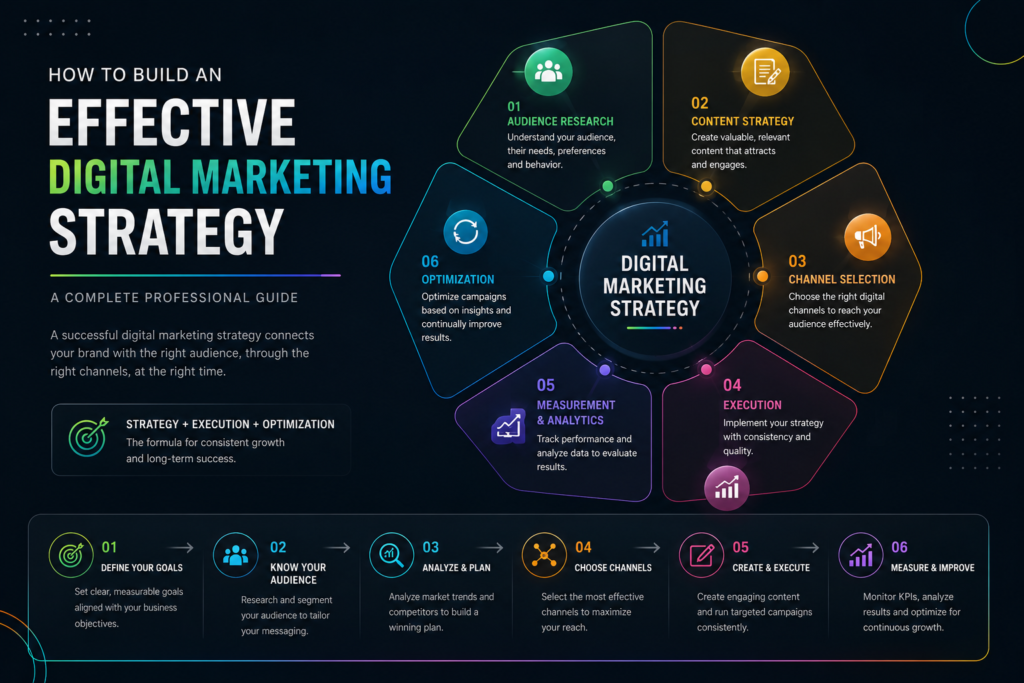
How to Build an Effective Digital Marketing Strategy
How to Build an Effective Digital Marketing Strategy is essential for businesses looking to succeed in the modern business landscape, where digital marketing has become a fundamental component of organizational growth and competitiveness. The rapid adoption of digital technologies has transformed the way businesses communicate with customers, promote their products and services, build brand awareness, and generate revenue. Consumers increasingly rely on search engines, social media, websites, online reviews, email, and digital platforms when researching and purchasing products or services. A well-planned effective digital marketing strategy helps businesses reach the right audience, strengthen their online presence, and achieve sustainable growth in an increasingly competitive digital environment.
However, simply maintaining a digital presence is not enough to achieve sustainable business growth. Organizations need a structured and data-driven approach to how to build an effective digital marketing strategy that aligns marketing activities with broader business objectives. An effective strategy enables businesses to identify their target audience, select appropriate digital channels, create relevant content, allocate resources efficiently, and measure marketing performance as part of an effective digital marketing strategy.
A successful digital marketing strategy is not a one-time activity. It is a continuous process of planning, implementation, analysis, optimization, and adaptation. This article explores the key components involved in developing an effective digital marketing strategy and provides a practical framework that businesses can use to strengthen their online performance.
What Is a Digital Marketing Strategy?
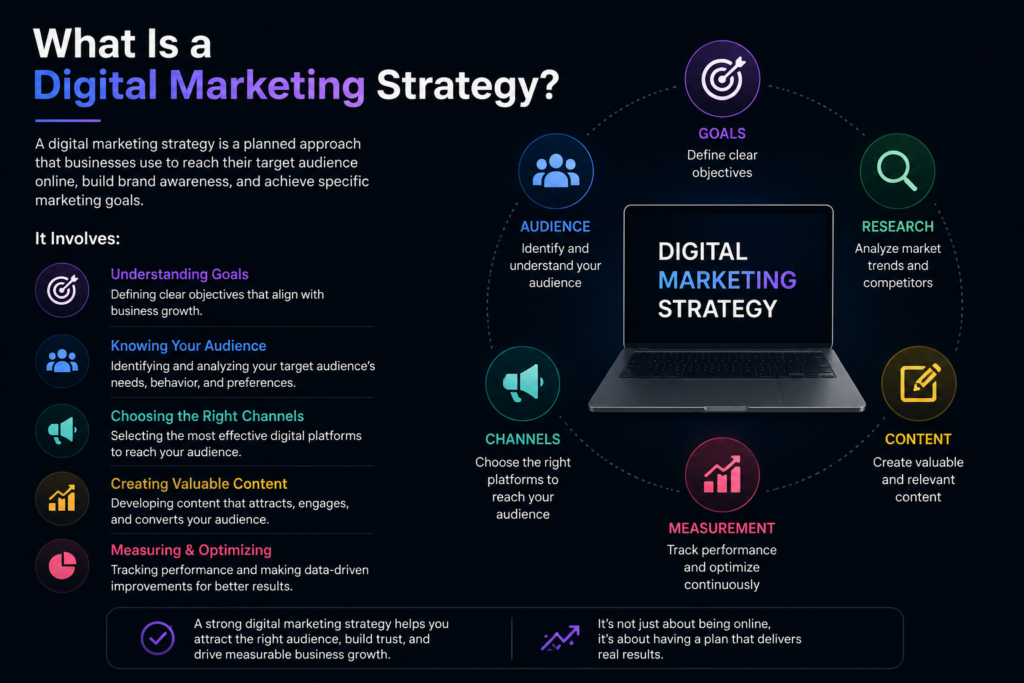
A digital marketing strategy is a comprehensive plan that defines how an organization will use digital channels and technologies to achieve specific marketing and business objectives. These channels may include search engines, websites, social media platforms, email, online advertising, content marketing, and other digital platforms.
Unlike individual marketing campaigns, which are usually designed around a specific objective or period, a digital marketing strategy provides an overall direction for digital activities. It establishes priorities, identifies target audiences, determines suitable channels, and defines how performance will be evaluated.
An effective strategy should connect digital marketing activities with measurable business outcomes such as increased revenue, customer acquisition, brand awareness, lead generation, or customer retention.
1. Establish Well-Defined Marketing Goals
A successful digital marketing strategy begins with a clear understanding of what the business wants to accomplish. Learning how to build an effective digital marketing strategy starts with defining specific business goals rather than adopting a digital platform simply because it is popular. Businesses should select marketing activities based on their specific needs, target audience, available resources, and measurable outcomes.
When considering how to build an effective digital marketing strategy, businesses should establish clear objectives such as increasing brand awareness, generating qualified leads, driving website traffic, improving customer engagement, increasing sales, or strengthening customer retention. These objectives provide direction and make it easier to measure the success of an effective digital marketing strategy.
Clear and measurable goals also help businesses choose the right digital marketing channels. Instead of trying to maintain a presence on every platform, businesses can focus their time and budget on channels that are most likely to reach their target audience and support their objectives. This focused approach is an important part of how to build an effective digital marketing strategy.
Ultimately, a strong effective digital marketing strategy should connect every marketing activity to a specific business objective. By setting clear goals, selecting appropriate channels, and tracking measurable results, businesses can build a digital marketing strategy that is focused, efficient, and capable of supporting long-term growth.
.
Well-defined objectives provide a clear direction for the marketing team and help ensure that time, budget, and resources are invested in the right areas. One effective approach is to use the SMART framework, which means goals should be Specific, Measurable, Achievable, Relevant, and Time-bound.
For instance, instead of setting a broad goal such as “get more visitors to the website,” a business could establish a measurable objective such as:
“Achieve a 30% growth in organic website visitors within six months by implementing targeted SEO strategies and publishing high-value content.”
This type of objective gives the marketing team a clear target and makes performance easier to track.
Depending on the organization’s priorities, digital marketing goals may include:
- Building greater brand recognition
- Attracting high-quality leads
- Increasing online revenue and sales
- Expanding the customer base
- Improving website visibility and traffic
- Increasing customer engagement and loyalty
- Improving the percentage of visitors who convert
- Achieving a stronger return on marketing investment
Once the objectives are established, businesses can select the most appropriate marketing channels, create relevant campaigns, and identify the key performance indicators (KPIs) needed to measure progress.
In short, a strong digital marketing strategy should begin with a destination. Clear goals provide that destination and give every marketing activity a measurable purpose.
2. Conduct Market and Competitor Research
Before implementing how to build an effective digital marketing strategy, businesses need a clear understanding of the market in which they operate. Market research is an essential step in building an effective digital marketing strategy, as it provides valuable insights into customer expectations, industry trends, competitive positioning, market demand, and emerging opportunities.
Understanding the market is a key part of how to build an effective digital marketing strategy because it helps businesses make informed decisions about their target audience, marketing channels, content, messaging, and overall positioning. Effective market research allows businesses to identify changing customer needs and develop a digital marketing strategy that is relevant to current market conditions.
Competitor analysis is an important part of how to build an effective digital marketing strategy. Businesses should examine competitors’ websites, search visibility, content strategies, social media activities, advertising approaches, customer reviews, keyword strategies, and overall digital presence. Analyzing these factors can help businesses understand what competitors are doing successfully and where their own effective digital marketing strategy can create a competitive advantage.
The objective is not to replicate competitors but to identify market gaps and opportunities for differentiation. When learning how to build an effective digital marketing strategy, businesses should use competitor insights to discover underserved audiences, content opportunities, unique value propositions, and areas where competitors may be failing to meet customer expectations.
A strong market and competitor analysis can also help businesses build a more focused effective digital marketing strategy. By understanding industry trends, customer behavior, competitor strengths, and market gaps, businesses can create more relevant content, choose better marketing channels, develop stronger campaigns, and position their brand more effectively.
Ultimately, market research and competitor analysis provide the foundation for how to build an effective digital marketing strategy that is informed by real market conditions rather than assumptions. By continuously monitoring competitors and changing market trends, businesses can refine their digital marketing strategy, identify new opportunities, and maintain a stronger competitive position over time.
A thorough competitive analysis can help answer important questions:
- Who are the major competitors?
- What digital channels are they using?
- Which topics and keywords are they targeting?
- What type of content generates engagement?
- What are customers saying about competing brands?
- Where are competitors performing well?
- What opportunities remain underserved?
These insights can help a business develop a more differentiated and competitive marketing strategy.
3. Identify and Understand the Target Audience
Understanding the target audience is central to how to build an effective digital marketing strategy. Businesses need to know not only who their customers are but also what they need, what challenges they face, how they make purchasing decisions, and which digital channels they use. A clear understanding of the target audience provides the foundation for creating an effective digital marketing strategy that connects with the right customers.
Audience research is an essential part of how to build an effective digital marketing strategy and can include demographic, geographic, behavioral, and psychographic characteristics. Businesses can also analyze existing customer data, website behavior, social media engagement, surveys, reviews, and market research. These insights help businesses understand customer expectations and make more informed digital marketing decisions.
Creating detailed buyer personas can make this information easier to apply when developing an effective digital marketing strategy. A buyer persona represents a typical customer and includes information such as their goals, challenges, preferences, purchasing behavior, interests, and information sources. Developing accurate buyer personas is an important step in how to build an effective digital marketing strategy, as it helps businesses create marketing activities around real customer needs.
A clear understanding of the audience enables businesses to develop more relevant messaging, content, offers, and customer experiences. When businesses understand how to build an effective digital marketing strategy around their target audience, they can improve engagement, attract more qualified leads, strengthen customer relationships, and increase conversions.
Ultimately, audience research should remain an ongoing part of an effective digital marketing strategy. Customer preferences, behaviors, technologies, and digital habits can change over time. Regularly updating audience insights allows businesses to refine their digital marketing strategy, deliver more personalized experiences, and remain relevant in a competitive digital environment.
4. Develop a Strong Digital Presence
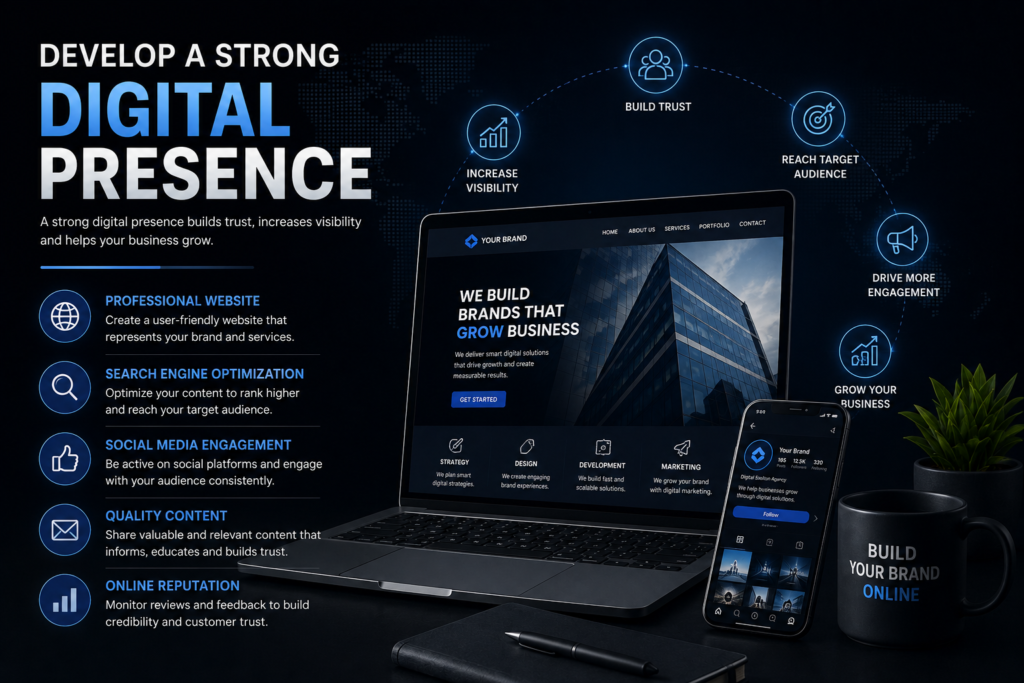
A company’s website is often the central point of its digital marketing ecosystem. Search engines, social media platforms, advertisements, email campaigns, and other channels frequently direct users to the company’s website.
Therefore, the website should provide a professional, accessible, and consistent user experience.
An effective business website should be:
- Mobile-responsive
- Fast and reliable
- Easy to navigate
- Secure
- Search-engine friendly
- Visually consistent with the brand
- Clear about products and services
- Optimized for conversions
Strong calls to action should guide visitors toward the next stage of the customer journey, whether that means making a purchase, submitting an inquiry, downloading a resource, or contacting the business.
5. Strengthen Your Online Visibility Through SEO
An effective SEO approach involves several key areas, including keyword research, technical SEO, on-page optimization, content creation, internal linking, website speed, mobile usability, and high-quality backlink development.
Keyword research provides valuable insight into the topics and queries that potential customers use when searching online. However, effective SEO is not simply about placing keywords throughout a webpage. Businesses should understand the search intent behind each query and create content that genuinely addresses the user’s needs, questions, or challenges.
Providing original, informative, and well-structured content can improve the overall user experience while helping a brand establish authority and credibility within its industry. A website should aim to answer questions effectively rather than create content solely for search engines.
SEO also requires continuous monitoring and improvement. Search algorithms, customer behavior, competitors, and industry trends can change over time, making regular analysis and optimization essential.
Ultimately, SEO should not be considered a quick method for generating website traffic. It is a long-term digital investment that can help businesses build stronger online visibility, attract relevant audiences, establish credibility, and achieve sustainable growth.
6. Develop a Strategic Content Marketing Plan
Content marketing plays an important role in how to build an effective digital marketing strategy by attracting and educating potential customers. Instead of relying exclusively on promotional messages, businesses can create useful content that addresses customer questions, builds trust, and demonstrates industry expertise as part of an effective digital marketing strategy.
Content can include:
- Blog articles
- Industry reports
- Case studies
- Videos
- Webinars
- Infographics
- E-books
- Guides
- Social media content
- Email newsletters
A professional content strategy should be based on audience needs, business objectives, and different stages of the customer journey. Understanding how to build an effective digital marketing strategy helps businesses create content that is relevant, purposeful, and aligned with customer expectations.
For example, educational content can attract users at the awareness stage, detailed comparisons can support evaluation, and case studies can help customers make purchasing decisions. These content types are important when developing an effective digital marketing strategy.
Maintaining a content calendar can improve consistency and ensure that content production remains aligned with strategic priorities, making it easier to build an effective digital marketing strategy.
7. Leverage Social Media Marketing
Social media enables organizations to communicate directly with existing and potential customers while building brand awareness and community.An effective social media strategy begins with selecting platforms that are relevant to the target audience.
Businesses don’t needto be active on every social media platform; instead, they should focus on the channels that best match their target audience and marketing goals. Content should be adapted to the characteristics of each channel while maintaining consistent brand positioning. Depending on the organization and audience, effective formats may include educational posts, short-form videos, customer stories, industry insights, product demonstrations, and interactive content.
Social media should also be treated as a customer communication channel. Responding to comments, questions, reviews, and messages can strengthen relationships and provide valuable insights into customer expectations.
8. Integrate Paid Digital Advertising
Paid advertising can complement organic marketing activities by providing businesses with faster access to targeted audiences. As part of how to build an effective digital marketing strategy, paid advertising allows businesses to reach potential customers based on factors such as search intent, interests, demographics, online behavior, and location.
Major forms of digital advertising include search advertising, social media advertising, display advertising, video advertising, and remarketing. Choosing the right advertising channels is an important part of how to build an effective digital marketing strategy, as businesses need to focus their budgets on platforms where their target audience is most active.
A professional paid media strategy should begin with a clearly defined objective and target audience. When learning how to build an effective digital marketing strategy, businesses should establish specific campaign goals such as increasing website traffic, generating leads, driving sales, or improving brand awareness. Campaign performance should then be evaluated using relevant metrics such as cost per click, conversion rate, cost per acquisition, and return on advertising spend.
Businesses should continuously test different creative formats, audience segments, messages, landing pages, and offers. This testing and optimization process is an important part of building an effective digital marketing strategy, allowing marketing teams to identify the most effective combinations and allocate advertising budgets more efficiently.
Ultimately, paid advertising should not operate as a standalone activity. It should work alongside SEO, content marketing, social media, email marketing, and other digital channels. Integrating paid campaigns into an effective digital marketing strategy can help businesses reach the right audience faster, improve conversions, maximize marketing ROI, and support long-term business growth.
9. Incorporate Email Marketing and Customer Retention
Acquiring new customers is important, but retaining existing customers can also contribute significantly to long-term business performance.
Email marketing provides businesses with a direct communication channel for nurturing prospects and maintaining relationships with existing customers.
Businesses can use email campaigns for newsletters, educational resources, product updates, personalized recommendations, promotional offers, and customer retention initiatives.
Audience segmentation and personalization can improve relevance and engagement. However, businesses should ensure that email communication is permission-based and provides genuine value to recipients.
10. Measure Performance Using Data and Analytics
A key benefit of digital marketing is its ability to provide clear and measurable results. Understanding how to build an effective digital marketing strategy involves analyzing data and performance metrics to identify which marketing strategies are delivering the best outcomes, while also recognizing areas that need adjustment or improvement.
Important performance indicators may include:
- Website traffic
- Conversion rate
- Cost per lead
- Customer acquisition cost
- Organic search performance
- Engagement rate
- Email click-through rate
- Revenue generated
- Customer lifetime value
- Return on investment
The most appropriate KPIs depend on the organization’s objectives.
For example, a brand-awareness campaign may focus on reach and engagement, while an e-commerce campaign may prioritize conversions, revenue, and return on advertising spend.
Data should not simply be collected; it should be analyzed and translated into actionable business decisions.
11. Optimize the Customer Journey
How to Build an Effective Digital Marketing Strategy should consider the entire customer journey rather than focusing only on attracting new visitors.
The customer journey generally includes stages such as awareness, consideration, conversion, retention, and advocacy. Understanding these stages is an important part of building an effective digital marketing strategy.
At each stage, customers may require different types of information and communication. Educational content may be appropriate during awareness, while product comparisons, demonstrations, testimonials, or case studies may be more valuable during consideration.
Businesses should identify potential barriers at each stage and optimize the experience accordingly. This approach helps create an effective digital marketing strategy that supports customers throughout their journey.
A smooth customer journey can improve conversion rates, customer satisfaction, and long-term loyalty.
12. Continuously Test, Optimize, and Adapt
Digital marketing is constantly changing. Search algorithms, consumer behavior, advertising platforms, technologies, and competitive conditions can evolve rapidly.
For this reason, a digital marketing strategy should be treated as a dynamic framework rather than a fixed document.
Businesses should regularly review performance, conduct experiments, evaluate customer feedback, and adjust their strategies.
A/B testing can be used to compare different versions of advertisements, landing pages, email subject lines, headlines, and calls to action. The results can provide evidence-based insights into customer preferences.
Continuous optimization allows businesses to improve performance while making more efficient use of their marketing resources.
Artificial Intelligence: Transforming the Future of Digital Marketing
Artificial intelligence is increasingly influencing the way businesses plan and execute digital marketing activities. Understanding how to build an effective digital marketing strategy now includes using AI to support areas such as customer segmentation, content ideation, predictive analytics, personalization, automation, and customer service.
However, technology should support marketing strategy rather than replace strategic thinking. Businesses still need accurate data, human oversight, strong brand positioning, and a clear understanding of their customers to build an effective digital marketing strategy.
Organizations that combine technology with customer insight and sound marketing principles can use AI more effectively while maintaining quality and authenticity. This approach is an important part of how to build an effective digital marketing strategy in an increasingly AI-driven digital environment.
Conclusion
How to Build an Effective Digital Marketing Strategy starts with a structured approach that connects business objectives with customer needs, appropriate digital channels, valuable content, and measurable outcomes. Understanding how to build an effective digital marketing strategy helps businesses create a clear roadmap for reaching their target audience, increasing online visibility, and achieving sustainable growth.
The process of how to build an effective digital marketing strategy begins with defining clear objectives and understanding the target audience. Businesses must then analyze their market and competitors, establish a strong digital presence, implement SEO and content marketing, leverage social media and paid advertising, develop customer-focused email campaigns, and measure performance through reliable data. Each of these elements plays an important role in creating an effective digital marketing strategy that delivers measurable business results.
Most importantly, learning how to build an effective digital marketing strategy means understanding that digital marketing is an ongoing process of learning, testing, and optimization. The digital environment continues to evolve, and successful organizations must be prepared to adapt their strategies according to changing customer expectations, emerging technologies, and market conditions. Regularly reviewing and improving your digital marketing strategy can help businesses remain competitive and relevant.
A well-designed effective digital marketing strategy does more than increase online visibility. It creates a systematic approach to attracting the right audience, building meaningful customer relationships, generating business opportunities, and achieving sustainable growth. Knowing how to build an effective digital marketing strategy allows businesses to connect their marketing activities with specific goals and measurable outcomes.
Ultimately, the most effective approach to how to build an effective digital marketing strategy combines clear objectives, deep customer understanding, valuable content, appropriate technology, data-driven decision-making, and continuous improvement. When these elements work together, an effective digital marketing strategy becomes a strategic business function rather than simply a collection of online promotional activities.
author: ramshad