
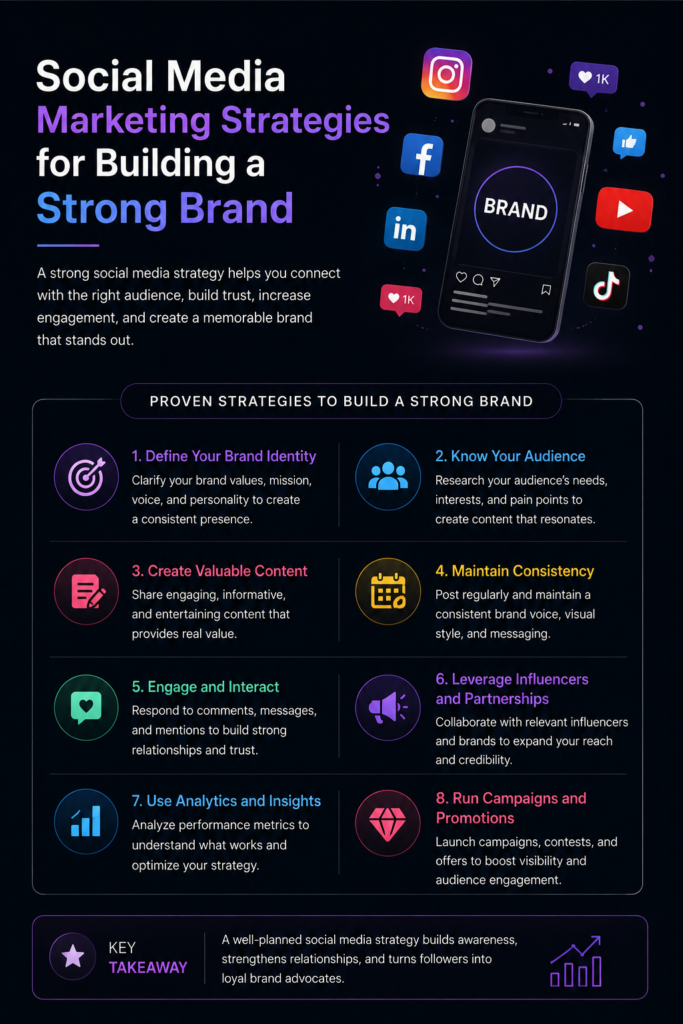
Social Media Marketing Strategies for Building a Strong Brand
have become increasingly important in today’s digital-first business environment. Social media is now one of the most influential channels for building brand awareness, communicating with customers, and creating long-term business value. Platforms such as Instagram, Facebook, LinkedIn, YouTube, TikTok, and other digital communities allow businesses to reach audiences at a scale that was difficult to achieve through traditional marketing alone. With the right social media marketing strategy, businesses can strengthen their online presence, connect with their target audience, and turn social engagement into meaningful brand growth.
However, simply creating social media accounts and publishing content regularly does not guarantee a strong brand presence. Successful social media marketing requires a strategic approach that combines clear brand positioning, audience understanding, consistent communication, valuable content, community engagement, and performance measurement.
A strong social media presence should do more than generate likes and followers. It should communicate what a brand represents, establish credibility, create meaningful customer relationships, and ultimately support business objectives.
This article explores the most effective social media marketing strategies businesses can use to build a strong, recognizable, and trustworthy brand.
What Is Social Media Marketing?
Social Media Marketing Strategies refer to the use of social networking platforms to promote a business, communicate with customers, distribute content, increase brand awareness, generate leads, and support business growth. Effective Social Media Marketing Strategies help businesses connect with the right audience and create a consistent presence across different digital platforms.
Unlike traditional advertising, Social Media Marketing Strategies provide businesses with opportunities for two-way communication. Customers can comment, share, review, recommend, question, and interact directly with brands. This direct interaction allows businesses to understand their audience better and build stronger customer relationships.
The interactive nature of social media makes it particularly valuable for brand building. Through effective Social Media Marketing Strategies, businesses can demonstrate their personality, share their expertise, respond to customer concerns, and develop communities around their products or services. Consistent content, meaningful engagement, and authentic communication can help turn casual followers into loyal customers.
A successful social media marketing strategy should therefore focus not only on promotion but also on relationship building. The best Social Media Marketing Strategies combine valuable content, audience engagement, brand consistency, creativity, and measurable goals. By using these strategies effectively, businesses can strengthen their online presence, increase brand awareness, build trust, and create long-term business growth.
1. Define a Clear Brand Identity
Before creating social media content, a business needs to establish a clear brand identity. Brand identity represents how an organization wants to be perceived by its target audience.
It includes elements such as:
- Brand values
- Mission and vision
- Personality
- Visual identity
- Tone of voice
- Unique selling proposition
- Brand positioning
For example, a technology company may position itself as innovative, professional, and forward-thinking, while a lifestyle brand may use a more friendly, creative, and conversational personality.
A clearly defined identity helps ensure that social media communication remains consistent across platforms.
Customers should be able to recognize a brand from its visual style, language, messaging, and overall presentation even when they encounter individual posts outside the company’s profile.
2. Understand Your Target Audience
Effective social media marketing begins with understanding the people a brand wants to reach.
Businesses should research their audience’s demographics, interests, behaviors, challenges, purchasing motivations, and preferred platforms.
Important questions include:
- Who is the ideal customer?
- What problems are they trying to solve?
- What type of content do they consume?
- Which social platforms do they use most?
- What influences their purchasing decisions?
- What questions do they frequently ask?
- What type of communication do they prefer?
Audience insights allow businesses to create content that is relevant rather than simply promotional.
For example, a B2B company may find that its audience responds strongly to professional insights, industry research, and educational content, while a consumer brand may benefit more from short-form videos, product demonstrations, and user-generated content.
3. Choose the Right Social Media Platforms
Businesses do not need to maintain an active presence on every social media platform.
Instead, they should focus their resources on platforms that align with their target audience and business objectives.
LinkedIn may be highly valuable for B2B organizations, professional services, and industry thought leadership. Instagram can be effective for visually driven brands, while YouTube is useful for long-form educational and demonstration content. Other platforms may be more appropriate depending on audience demographics and content formats.
The goal is not to maximize the number of platforms. It is to maximize meaningful audience engagement.
A focused strategy allows businesses to produce better content and maintain consistency without unnecessarily spreading their resources.
4. Develop a Consistent Content Strategy
Consistency is one of the foundations of successful social media branding.
A business should establish a content strategy that defines what it will publish, who the content is for, what objectives it supports, and how frequently it will be distributed.
A useful social media content mix can include:
- Educational content
- Industry insights
- Product or service information
- Customer stories
- Behind-the-scenes content
- User-generated content
- Company news
- Inspirational content
- Short-form videos
- Polls and interactive posts
Businesses should avoid making every post a direct sales pitch. Excessive promotional content can reduce engagement and make the brand feel less authentic.
Instead, businesses should aim to provide a balance of information, entertainment, inspiration, and commercial communication.
5. Create Valuable and Relevant Content
Content is at the center of social media marketing. However, publishing frequently is not enough. Content should be meaningful, useful, and relevant to the audience’s needs and interests.
Valuable content can educate customers, solve problems, answer questions, entertain audiences, or provide useful insights.
For example, a digital marketing agency could publish content explaining SEO techniques, social media strategies, marketing trends, and common business mistakes rather than continuously promoting its services.
High-quality content can strengthen brand authority and encourage people to view the business as a reliable source of information.
Over time, this credibility can influence purchasing decisions and customer loyalty.
6. Build a Strong Visual Identity
Social media is highly visual, making consistent design an important element of effective Social Media Marketing Strategies and long-term brand recognition. Businesses should maintain consistency in colors, typography, photography, graphics, logos, and overall visual style to create a recognizable identity across different social platforms.
A strong visual identity does not mean every post needs to look identical. Instead, individual pieces of content should share recognizable design characteristics that support the brand’s overall Social Media Marketing Strategies. Consistent visuals can make a business easier to recognize and help create a stronger connection with its target audience.
Professional visuals can improve brand credibility and make content easier for audiences to identify while scrolling through crowded social feeds. As part of successful Social Media Marketing Strategies, businesses should use high-quality graphics, branded templates, engaging images, and visually appealing content to capture attention and communicate their message effectively.
Video should also be considered an important part of visual branding and modern Social Media Marketing Strategies. Product demonstrations, tutorials, interviews, customer testimonials, and behind-the-scenes videos can help audiences understand the people, personality, and values behind a business.
By combining consistent branding with engaging visual content, businesses can make their Social Media Marketing Strategies more memorable and effective. A strong visual approach can increase recognition, improve engagement, strengthen brand credibility, and help businesses stand out in an increasingly competitive social media environment.
7. Use Storytelling to Humanize the Brand
People connect with stories more easily than with purely promotional messages.
Storytelling allows businesses to communicate their purpose, values, challenges, achievements, and customer experiences in a more memorable way.
Businesses can tell stories about:
- How the company was founded
- Why a product was developed
- Customer success experiences
- Employee achievements
- Business challenges and lessons
- Community initiatives
- Behind-the-scenes activities
Authentic storytelling can make a brand feel more human and relatable.
Rather than simply saying that a product is high quality, a business can demonstrate quality through customer experiences, production processes, case studies, or real-world results.
8. Engage With Your Community
Social media should not be treated as a one-way broadcasting channel.
Businesses need to actively communicate with their audience by responding to comments, answering questions, acknowledging feedback, and participating in relevant conversations.
Community management can significantly influence how customers perceive a brand.
A timely and helpful response to a customer question can demonstrate professionalism, while thoughtful responses to criticism can show accountability.
Businesses should also encourage conversation through polls, questions, discussions, and interactive content.
The objective is to build a community around the brand rather than simply accumulate followers.
9. Encourage User-Generated Content
User-generated content (UGC) is content created by customers rather than directly by the brand, and it has become an important element of effective Social Media Marketing Strategies. Examples include customer reviews, testimonials, product photographs, videos, and social media posts featuring a company’s products or services.
UGC can strengthen credibility because potential customers often value the experiences and opinions of other consumers. By incorporating authentic customer experiences into their Social Media Marketing Strategies, businesses can build trust, increase engagement, and create stronger connections with their target audience.
Businesses can encourage UGC by creating campaigns, requesting customer reviews, featuring customer stories, or developing branded hashtags. Including user-generated content in Social Media Marketing Strategies can also help brands create a steady stream of authentic content while encouraging customers to actively participate in the brand community.
As part of effective Social Media Marketing Strategies, businesses should use UGC strategically across relevant platforms and content formats. Customer-generated content can support brand awareness, social proof, engagement, and purchasing decisions while making a brand feel more authentic and relatable.
When using customer-generated content, businesses should obtain appropriate permission and give proper credit. Responsible use of UGC should always be an important part of Social Media Marketing Strategies, ensuring that brands respect customer rights while building trust and maintaining an authentic online presence.
10. Work With Relevant Influencers and Creators
Influencer and creator marketing can help brands reach established communities and increase credibility.
However, choosing an influencer based solely on follower count can be a mistake.
Businesses should evaluate:
- Audience relevance
- Engagement quality
- Content style
- Brand alignment
- Credibility
- Audience demographics
- Previous partnerships
A creator with a smaller but highly relevant audience may generate more meaningful results than a celebrity with millions of followers but little connection to the product.
The most effective partnerships are usually based on genuine alignment between the creator, audience, and brand.
11. Use Paid Social Media Advertising
Organic content is valuable for building relationships, but paid advertising can help businesses reach specific audience segments at scale.
Social media advertising allows businesses to target audiences based on factors such as interests, demographics, behaviors, and previous interactions.
Paid campaigns can be used for:
- Brand awareness
- Website traffic
- Lead generation
- Product promotion
- Event registration
- App downloads
- Online sales
Businesses should establish clear objectives before launching campaigns and measure performance against those objectives.
Testing different creative formats, messages, audiences, and calls to action can help improve campaign efficiency.
12. Measure Social Media Performance
A professional social media strategy must be supported by measurement and analysis.
Businesses should identify KPIs that align with their objectives.
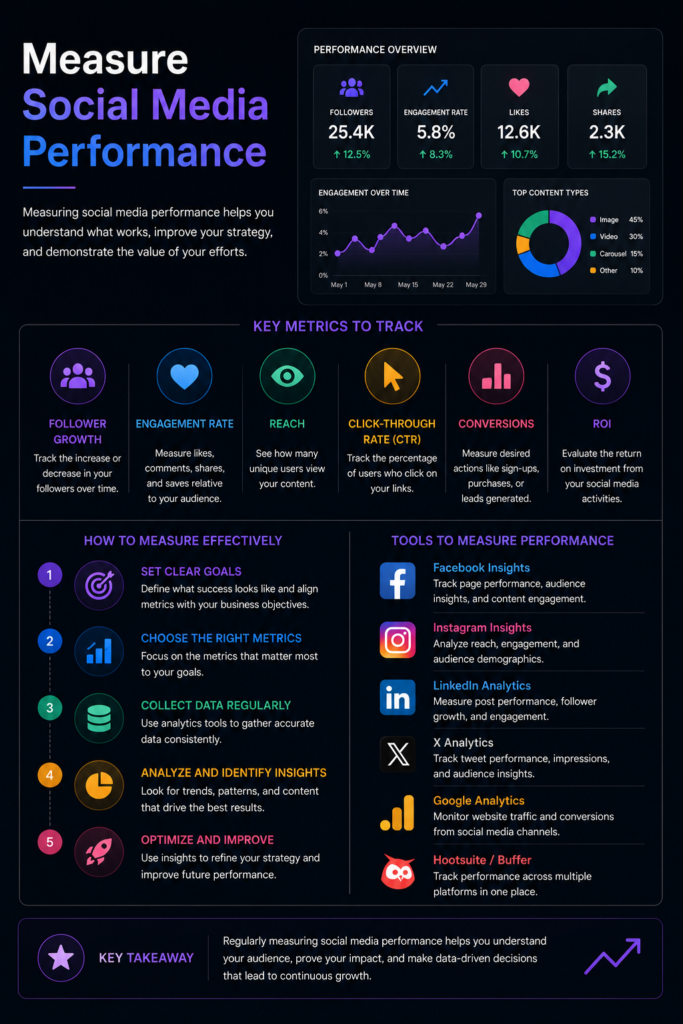
Important metrics may include:
- Reach
- Impressions
- Engagement rate
- Follower growth
- Website traffic
- Leads generated
- Conversion rate
- Cost per acquisition
- Revenue generated
However, businesses should avoid focusing exclusively on vanity metrics.
For example, a post receiving thousands of likes may generate little business value, while a smaller post may produce highly qualified leads.
The most important question is not simply, “How many people interacted with the content?” but rather, “Did the activity contribute to our business objectives?”
13. Maintain Brand Consistency Across Platforms
Customers may encounter a business across multiple digital channels. Therefore, maintaining a consistent brand experience is essential.
The company’s logo, colors, messaging, tone, values, and positioning should remain recognizable across social platforms.
At the same time, content should be adapted to the unique characteristics of each platform.
For example, a detailed industry article may work well on LinkedIn, while the same idea could be transformed into a short video or carousel for another platform.
Consistency should therefore mean consistent brand identity—not identical content everywhere.
14. Adapt to Emerging Trends
Social media is constantly evolving, making adaptable Social Media Marketing Strategies more important than ever. New content formats, technologies, algorithms, and consumer behaviors can influence how audiences discover, engage with, and interact with brands. Businesses that regularly update their Social Media Marketing Strategies can stay relevant and respond more effectively to changing audience expectations.
Artificial intelligence, short-form video, social commerce, creator marketing, personalization, and community-based marketing are among the key areas shaping the modern social media environment. Incorporating relevant trends into Social Media Marketing Strategies can help businesses improve engagement, expand their reach, strengthen brand awareness, and create more meaningful connections with their audiences.
Businesses should monitor relevant developments and experiment strategically when developing their Social Media Marketing Strategies. Testing new content formats, platforms, and technologies can help brands discover what works best for their audience while avoiding unnecessary investment.
However, not every trend is appropriate for every brand. Effective Social Media Marketing Strategies should be based on the brand’s audience, resources, industry, and business objectives. Before investing heavily in a new platform or format, businesses should evaluate whether it supports their overall Social Media Marketing Strategies and can deliver meaningful results. A flexible, data-driven approach allows brands to adopt useful trends while maintaining a consistent identity and long-term marketing direction.
15. Focus on Long-Term Brand Building
One of the biggest mistakes businesses make is expecting immediate results from social media.
Building a strong brand requires time and consistency. Customers need repeated exposure to a company’s messaging, content, values, and experiences before trust develops.
Businesses should therefore focus on long-term objectives such as:
- Building recognition
- Establishing authority
- Developing community
- Increasing customer loyalty
- Strengthening reputation
- Creating meaningful relationships
Short-term campaigns can generate immediate results, but consistent long-term brand building creates more sustainable value.
Conclusion
Social media marketing has become an essential component of modern brand-building strategies. However, successful social media marketing involves much more than posting content regularly or gaining followers.
A strong strategy begins with a clearly defined brand identity and a deep understanding of the target audience. Businesses must then select the right platforms, develop valuable content, maintain visual and messaging consistency, engage with their communities, and use tools such as influencer partnerships and paid advertising strategically.
Most importantly, businesses should measure their results and continuously refine their approach based on data and customer feedback.
The strongest brands on social media are not necessarily those that publish the most content. They are the brands that understand their audiences, communicate consistently, provide genuine value, and build authentic relationships over time.
In an increasingly competitive digital environment, social media provides businesses with an opportunity to move beyond traditional promotion and create meaningful connections with customers. When supported by clear objectives, strong content, authentic communication, and continuous optimization, social media marketing can become a powerful foundation for building a recognizable, trusted, and sustainable brand.
authoe: ramshad