
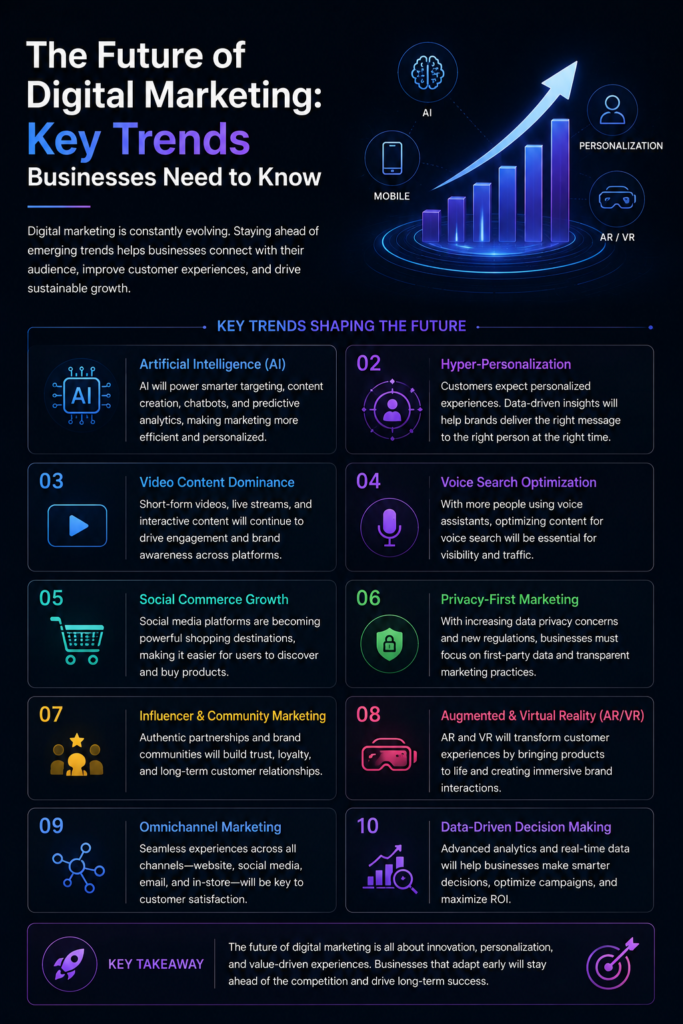
Digital marketing has evolved from a supporting business function into one of the most important drivers of growth, customer engagement, and brand visibility. The rapid development of artificial intelligence, changing consumer behavior, new search experiences, social commerce, automation, and data-driven marketing is reshaping how businesses connect with their audiences.
In 2026, consumers are no longer following a simple path from search to website to purchase. They discover brands through search engines, social media, creators, videos, online communities, messaging platforms, and increasingly through AI-powered experiences. Google describes this shift as a move toward more conversational, multimodal, and personalized search, while social platforms are increasingly combining discovery, shopping, and customer service.
For businesses, this transformation creates significant opportunities—but it also introduces new challenges. Organizations that understand emerging trends and adapt their strategies can strengthen their competitive position, while businesses that rely exclusively on traditional digital marketing methods may struggle to remain visible.
This article explores the major trends shaping the future of digital marketing and explains how businesses can prepare for the next stage of digital growth.
1. Artificial Intelligence Will Become Central to Marketing
Artificial intelligence is arguably the most significant force influencing the future of digital marketing. AI is already being used for content creation, audience analysis, customer segmentation, campaign optimization, personalization, predictive analytics, and customer service.
The next phase will move beyond using AI simply as a productivity tool. Businesses are increasingly exploring AI systems that can analyze information, make recommendations, automate processes, and support customer interactions.
Gartner predicts that organizations will increasingly adopt agentic AI for personalized customer interactions, including activities such as notifications, recommendations, and reorders.
For marketers, this means AI skills will become increasingly important. However, successful AI marketing will not depend entirely on automation. Human creativity, strategic thinking, brand knowledge, and judgment will remain essential.
Businesses should therefore focus on developing a human-AI marketing model in which technology improves efficiency while people remain responsible for strategy, creativity, quality, and ethical decision-making.
2. Search Is Becoming More Conversational and AI-Powered
Search engine marketing is entering a new phase. Traditional search was largely based on short keyword queries and lists of web pages. Increasingly, consumers can ask detailed questions and receive AI-generated responses that help them explore options and make decisions.
Google reports that AI-powered Search is supporting longer, more conversational queries and increasingly multimodal interactions involving text, images, and other forms of input.
This change has important implications for SEO.
Businesses should no longer focus exclusively on ranking for individual keywords. Instead, they should develop comprehensive content that answers complex questions, demonstrates expertise, provides original insights, and satisfies user intent.
Google’s current guidance emphasizes that creating useful, people-first content remains central to visibility in AI-powered search.
The future of SEO will therefore involve a combination of traditional technical SEO, authoritative content, strong brand reputation, structured information, and a deep understanding of customer questions.
3. Generative Engine Optimization Will Gain Importance
As consumers increasingly use AI systems to discover information, products, and services, businesses are paying greater attention to how their brands appear within AI-generated answers.
This has led to growing interest in Generative Engine Optimization, often referred to as GEO. The concept focuses on improving the likelihood that a business, product, or source will be recognized and referenced in AI-driven discovery experiences.GEO should be viewed as a complementary approach to traditional SEO rather than a complete substitute. While GEO focuses on improving a brand’s visibility within AI-generated search experiences, strong SEO fundamentals—such as authoritative content, technical website performance, relevant keywords, and a positive user experience—remain essential for long-term online visibility.
. Strong fundamentals remain important. High-quality content, technical accessibility, authority, accurate business information, and useful user experiences provide the foundation for visibility across both traditional and AI-powered search.
The practical lesson is simple: businesses should create content that is genuinely useful to people rather than attempting to manipulate AI systems.
4. Personalization Will Become More Sophisticated
Consumers increasingly expect brands to understand their needs and provide relevant experiences. Generic marketing messages are becoming less effective in an environment where businesses have access to increasingly sophisticated customer data and technology.
AI and marketing automation can help businesses personalize website experiences, product recommendations, email campaigns, advertisements, and customer communications.
The future of personalization, however, will require a careful balance between relevance and privacy. Customers want useful experiences, but they also expect transparency and responsible data practices.
Businesses should therefore collect and use customer data responsibly, clearly communicate how information is used, and prioritize customer trust.
5. Social Media Will Become a Discovery and Commerce Platform
Social media is evolving beyond its traditional role as a communication channel. Platforms are increasingly functioning as search engines, entertainment ecosystems, shopping environments, and customer-service channels.
Recent research from HubSpot indicates that social discovery, social commerce, short-form video, creator marketing, and community building are major developments shaping social media in 2026.
This means businesses should think beyond simply gaining followers. The focus should be on creating content that people want to discover, share, discuss, and act upon.
For e-commerce brands in particular, social platforms can shorten the path between product discovery and purchase.
In India, Meta has highlighted the growing importance of AI, Reels, creators, and conversational messaging in the country’s evolving shopping journey.
6. Short-Form Video Will Remain a Major Content Format
Video continues to be one of the most influential formats in digital marketing. Short-form video is particularly valuable because it allows businesses to communicate information quickly while competing effectively for audience attention.
Businesses can use video for:
- Product demonstrations
- Educational content
- Customer testimonials
- Behind-the-scenes content
- Tutorials
- Brand storytelling
- Expert interviews
- Short-form advertisements
The future of video marketing will not simply be about producing more videos. Quality, relevance, authenticity, and storytelling will become increasingly important.
AI tools may reduce the cost and time required to produce video content, but businesses should avoid producing large amounts of generic AI-generated material. Human creativity and authentic brand experiences will remain valuable differentiators.
7. Authenticity Will Become a Competitive Advantage
As AI makes it easier to produce large volumes of digital content, the value of authentic human experiences is likely to increase.
Consumers are exposed to enormous amounts of advertising and automatically generated content. As a result, businesses need to demonstrate genuine expertise, credibility, personality, and transparency.
This is particularly important for influencer and creator marketing. Gartner expects greater emphasis on creator authenticity as AI-generated media increases and concerns about misinformation and deepfakes grow.
Brands should therefore focus on building real relationships with creators and communities rather than relying only on follower counts.
Customer reviews, original research, expert opinions, behind-the-scenes content, and real customer stories can also help businesses establish credibility.
8. Marketing Automation Will Become More Intelligent
Automation has already changed email marketing, lead nurturing, advertising, customer support, and reporting. The future will involve more intelligent automation capable of adapting to customer behavior.
Instead of sending the same message to every customer, automated systems can respond to individual actions and signals.
For example, an online retailer could automatically recommend relevant products based on browsing behavior, previous purchases, and customer preferences.
However, automation should improve the customer experience rather than make communication feel impersonal. Businesses need to monitor automated systems carefully and ensure that customers can access human assistance when necessary.
9. Data and Analytics Will Drive Better Decisions
The future of digital marketing will be increasingly data-driven. Businesses need reliable information to understand customer behavior, evaluate campaigns, allocate budgets, and identify growth opportunities.
Important metrics may include:
- Customer acquisition cost
- Conversion rate
- Customer lifetime value
- Return on advertising spend
- Website engagement
- Lead quality
- Revenue by marketing channel
- Customer retention
- Brand awareness
The focus should move beyond measuring activity to measuring business outcomes.
For example, having a large number of social media followers may appear impressive, but if those followers do not engage with the brand or contribute to business objectives, the number alone has limited value.
Effective marketing teams will increasingly combine data from multiple channels to understand the complete customer journey.
10. Privacy and Trust Will Become More Important
The future of digital marketing will not be determined by technology alone. In the future, earning and maintaining customer trust will be one of the most important strengths a business can develop. Consumers are becoming increasingly conscious of the ways businesses gather, manage, and utilize their personal data.
At the same time, AI introduces new concerns involving misinformation, deepfakes, automated decision-making, and inaccurate brand representations.
Businesses therefore need strong governance around customer data and AI systems.
Privacy should not be viewed merely as a legal requirement. It should be treated as part of the customer experience and brand reputation.
Companies that demonstrate transparency and responsible use of technology can build stronger long-term relationships with customers.
11. The Customer Journey Will Become Less Linear
Traditional marketing models often describe a customer journey as a sequence: awareness, consideration, conversion, and retention.
Digital behavior is becoming much less predictable.
A customer might discover a product through a short video, research it using an AI assistant, compare prices through a search engine, read reviews on a social platform, ask questions through messaging, and then complete a purchase.
Google describes this changing environment as a customer journey in which people are simultaneously searching, streaming, scrolling, and shopping.
Businesses therefore need to create consistent experiences across multiple touchpoints instead of optimizing each channel independently.
12. Businesses Will Need to Combine Technology With Human Creativity
One of the biggest misconceptions about the future of digital marketing is that technology will replace marketers.
In reality, technology is more likely to change what marketers spend their time doing.
AI can analyze data, automate repetitive tasks, generate initial content ideas, and assist with campaign optimization
The strongest organizations will combine technological efficiency with human creativity.
How Businesses Can Prepare for the Future
Businesses do not need to adopt every new technology immediately. Instead, they should develop a flexible digital marketing strategy that can evolve as technology and consumer behavior change.
Organizations should focus on several priorities:
Invest in quality content: Create original, useful, expert-led content that provides genuine value.
Develop AI capabilities: Train marketing teams to use AI responsibly and effectively.
Strengthen SEO foundations: Maintain technically sound websites and publish authoritative content.
Understand customer behavior: Use analytics and research to understand how customers discover and evaluate brands.
Build authentic communities: Focus on relationships rather than vanity metrics such as follower counts.
Prioritize privacy: Use customer data responsibly and communicate transparently.
Experiment continuously: Test emerging platforms and technologies while measuring their business impact.
Conclusion
The future of digital marketing will be shaped by artificial intelligence, conversational search, personalization, social commerce, video, automation, data analytics, and changing consumer expectations. These developments are already influencing how people discover information, evaluate brands, and make purchasing decisions.
However, technology alone will not determine which businesses succeed. The most effective digital marketing strategies will combine advanced technology with strong fundamentals: customer understanding, valuable content, creativity, authenticity, trust, and measurable business objectives.
AI may change how marketing is executed, but the fundamental purpose of marketing remains the same—to understand customers and provide value.
Businesses that begin preparing now by strengthening their digital foundations, developing AI capabilities, investing in high-quality content, and building trusted customer relationships will be better positioned for the future.
The next generation of digital marketing will not simply be about being present on more platforms. It will be about being more relevant, more intelligent, more personalized, and more trustworthy at every stage of the customer journey.